
Chancellor John Healey delivered his maiden Budget on October 28, promising to provide “breathing space” for households while maintaining the fiscal rules outlined the 2024 Labour Party manifesto.
While much of the public discussion has centred on changes affecting households and government spending, the Budget also signalled a continued shift towards increased HMRC enforcement activity and further digitalisation of the UK tax system.
For firms operating in the wealth management sector, understanding these changes is about more than simply keeping pace with new legislation. It is about ensuring clients remain compliant, identifying planning opportunities and maintaining the accuracy and efficiency of tax reporting processes in an increasingly complex regulatory environment.
In this article, we examine the key announcements from the Autumn Budget 2026 and explore what they could mean for wealth managers, advisers, investment platforms and the investors they support.
The 2026 Autumn Budget Budget in Brief:
- A two-percentage point increase in tax rates on savings and property income from April 2027.
- Reversal of the proposed reduction in the Cash ISA allowance for under-65s.
- Exploration of a new ISA product aimed at encouraging first-time investors.
- Reduction of the Business Asset Disposal Relief (BADR) lifetime limit to £500,000 from April 2027.
- Introduction of a new Founder’s Relief for qualifying business founders from April 2027.
- Smaller, regular payments for taxpayers who make Payments on Account for Income Tax Self Assessment from April 2029.
- A consultation on expanding tis third-party reporting requirements for property income data.
- A new multi-year strategy for managing the compliance of wealthy taxpayers.
- Recruitment of 670 new compliance officers and new debt recovery powers for HMRC.
Higher Tax Rates on Savings and Property Income
Tax rates on savings and property income will increase by a further two percentage points from April 2027.
Rates will rise from:
- 20% to 24% for basic-rate taxpayers
- 40% to 44% for higher-rate taxpayers
- 45% to 49% for additional-rate taxpayers
The rates on savings income will apply across the UK, while the property income changes will apply in England, Wales and Northern Ireland.
Although HMRC stated that 84% of income taxpayers will be unaffected, higher-income investors and landlords are likely to face increased tax liabilities as a result of these changes. This may increase demand for tax-efficient investment strategies and more sophisticated tax planning support.
Income Tax Thresholds Remain Frozen
The Budget confirmed that Income Tax thresholds will remain frozen until 2031.
The personal allowance will remain at £12,570, while the higher-rate threshold will stay at £50,270.
As inflation and earnings growth continue over time, frozen thresholds will result in more taxpayers being drawn into higher tax bands. This reinforces the importance of ongoing tax planning and regular client reviews.
Cash ISA U-Turn
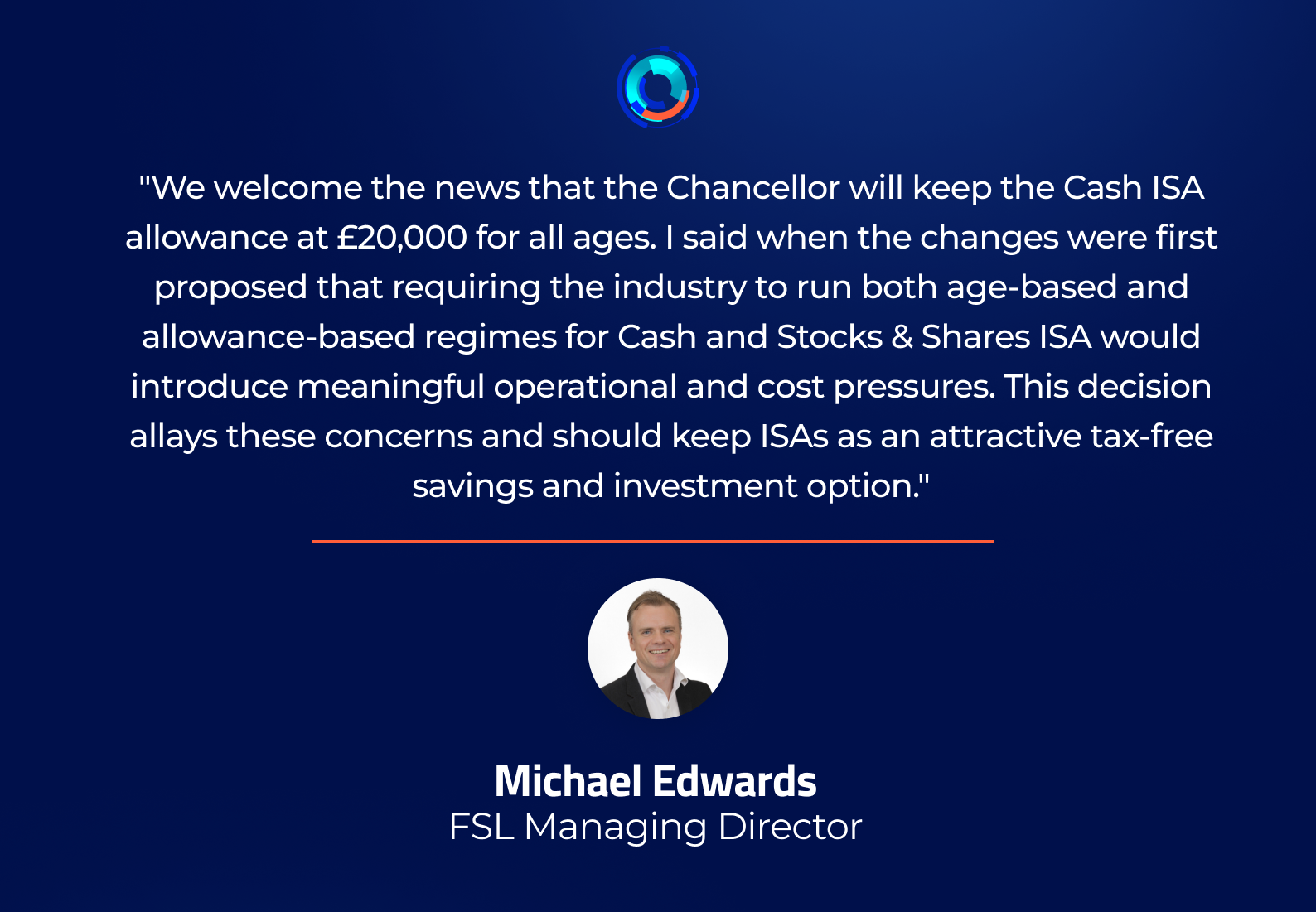
The Government has reversed plans announced in the 2025 Autumn Budget to reduce the annual Cash ISA allowance for individuals under 65 from £20,000 to £12,000.
The allowance will therefore remain at £20,000 for all eligible savers.
For advisers and platforms, the decision removes a potentially significant source of complexity and preserves the flexibility many investors value when managing cash holdings within tax-efficient wrappers.
New ISA for First-Time Investors
The Government is exploring the introduction of a new ‘starter’ ISA designed to encourage investment among first-time investors. Although details currently remain limited, the proposal reflects ongoing efforts by the government to increase retail participation in investing.
The outcome of the upcoming consultation will be closely watched by platforms, advisers and investment providers, particularly if the new product introduces additional incentives or contribution limits.
Business Asset Disposal Relief Reduced
The lifetime limit for Business Asset Disposal Relief will be reduced to £500,000 from April 2027. According to the Treasury, the decision to reduced BADR from the current £1 million limit is expected to have no impact on three in four existing claimants.
Business owners considering succession planning, company sales or retirement strategies may wish to review their plans ahead of implementation.
New Founder's Relief to be Introduced
A new Founder’s Relief will be introduced from April 2027 for the capital gains tax regime.
Under the proposals, qualifying founders of high-growth, innovative companies will be eligible for a 10% capital gains tax rate on up to £10 million of lifetime gains. The measure is intended to support entrepreneurship, encourage investment in innovative businesses and provide a more targeted incentive for business creation and growth.
Further detail on eligibility criteria is expected, following consultation, in a future Finance Bill.
Increased Focus on Wealthy Taxpayer Compliance
The Government has published a new multi-year plan to modernise the approach to the compliance of wealthy taxpayers. The strategy centres on greater use of data, technology and specialist expertise to address non-compliance earlier and improve HMRC’s understanding of individual’s complex tax affairs.
HMRC defines a wealthy taxpayer as those with income over £200,000 or assets over £2 million in any of the last three years. It estimates there around 1.3 million wealth taxpayers in the UK, accounting for £160 billion in tax receipts in 2025-26.
However, HMRC also estimates that wealthy taxpayers accounted for £3.6 billion of the UK’s tax gap in 2024-25, representing approximately 6% of the total gap.
More Compliance Officers and Enhanced Debt Recovery Powers
The Budget committed to an additional 670 compliance officers by 2029-30, building on previous commitments to recruit 5,500 additional compliance officers.
It also announced that, alongside existing tools to recover high-value debt, the government will provide HMRC with new powers to enable the direct recovery of lower-value debt.
While the Government has committed to developing a formal Code of Practice before introducing legislation, the direction of travel is clear: increased enforcement activity supported by greater operational capacity and improved access to data.
Financial advisers and wealth managers should expect continued scrutiny of tax reporting processes and increasing emphasis on data quality and compliance controls.
A More Modern Tax System
The Government reiterated its commitment to making the tax system easier to navigate while improving overall tax collection. A central part of this agenda is the modernisation of the existing Payments on Account system for Income Tax Self Assessment.
From April 2029, taxpayers who currently make Payments on Account will begin making smaller, more regular contributions throughout the year. The Government believes this will help reduce the risk of unexpected liabilities and improve overall compliance.
For advisers and wealth managers, the change may create new planning considerations around client cash management and tax payment schedules, particularly for clients with complex income patterns.
The Treasury estimates the measure will raise £1.6 billion in 2030-31.
Expanding the Use of Third-Party Data
The Government will consult on extending third-party reporting requirements for property income.
This proposal builds on the wider trend towards increased data sharing between third parties and HMRC, providing tax authorities with greater visibility over taxpayer activity. The aim is to improve compliance, reduce reporting errors and minimise unnecessary HMRC interventions.
For firms managing clients with property portfolios, this development highlights the growing importance of accurate record keeping and consistent reporting across platforms and tax systems.
Navigating Change with Confidence
The Autumn Budget 2026 introduces a broad range of measures that will influence how advisers, wealth managers and investors approach tax planning, compliance and investment decisions over the coming years.
As HMRC continues to expand its use of data and increase compliance activity, accurate tax calculations, robust reporting processes and reliable client data will become increasingly important.
At FSL, we’re committed to helping firms stay ahead of legislative change. Through CGiX, we support advisers, wealth managers and investment platforms with the tools they need to maintain accuracy, improve efficiency and remain compliant in an evolving tax environment.
Get in touch to learn how CGiX can help your business prepare for what’s next.
- Introduction
- Higher Tax Rates on Savings and Property Income
- Income Tax Thresholds Remain Frozen
- Cash ISA U-Turn
- New ISA for First-Time Investors
- Business Asset Disposal Relief Reduced
- New Founder's Relief to be Introduced
- Increased Focus on Wealthy Taxpayer Compliance
- More Compliance Officers and Enhanced Debt Recovery Powers
- A More Modern Tax System
- Expanding the Use of Third-Party Data
- Navigating Change with Confidence